By Dr Nikhil Sharma, Specialist Orthodontist at IB Clinic Dubai (Invisible Braces Dental and Skin Polyclinic), Sheikh Zayed Road, Trade Centre, Dubai
Short answer
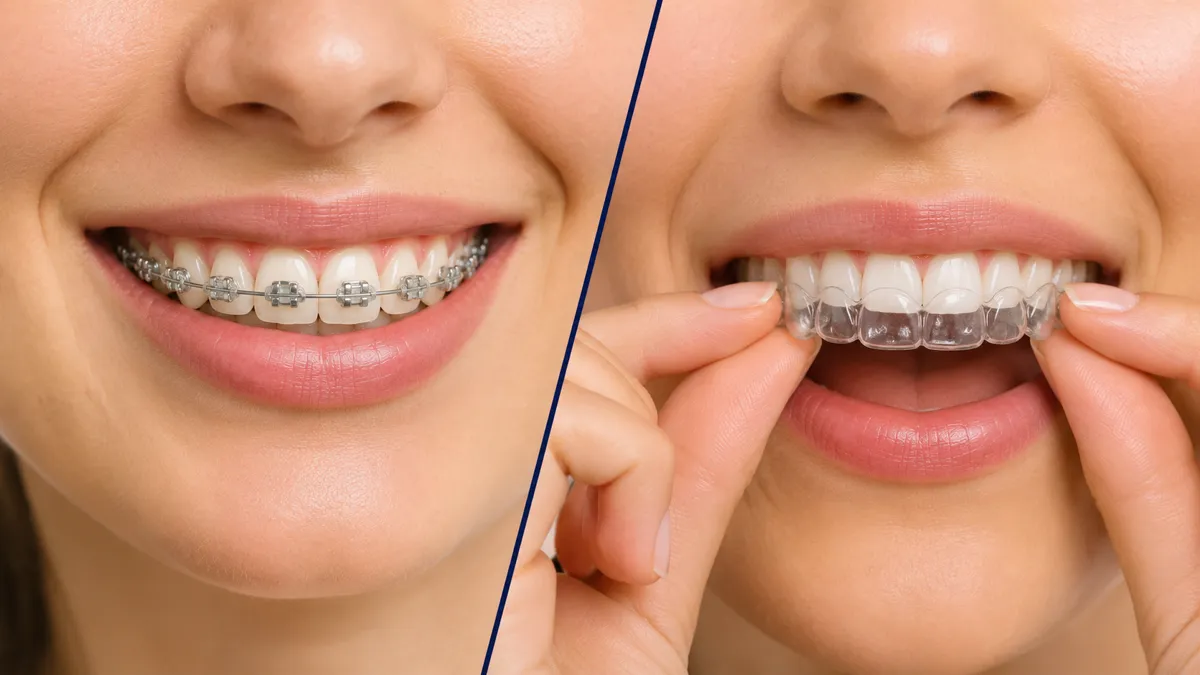
It depends what you mean by better. If you mean removable and less visible, Invisalign has obvious advantages, and patients report less pain in the first days of treatment (Li et al., 2023 [1]). If you mean better at moving every tooth, no. A 2025 meta-analysis of 15 trials and 1,084 patients found no difference in result quality or treatment time for non-extraction cases, and braces were superior in extraction cases [2]. A Dubai study found Invisalign achieved on average 50% of the tooth movement it planned [3]. I do not choose a winner. I choose the appliance that suits the plan for your case, decided from your records.
Key points
- Removable and less visible are real advantages. Aligners also cause less pain on days 3 and 4 [1].
- For non-extraction cases, result quality and treatment time are similar; braces are superior in extraction cases [2].
- Aligners deliver roughly half the movement they plan [3, 4], so some cases need more control than they offer.
- Rotations, bite opening and vertical movements are the least predictable with aligners [5, 6, 7].
- The case, the movements, compliance, the bite and the goals decide the appliance. The plan comes first.
The full article
“Invisalign is better than braces.”
Patients say this to me in Dubai as if it has been settled. Sometimes the opposite, with the same confidence: braces are the real treatment and aligners are for mild cases. Both are stated as facts. Neither is the question I ask.
Is Invisalign better than braces?
It depends what you mean. If by “better” you mean removable and less visible, Invisalign has obvious advantages, and I would not argue with a patient who values those. In a 2023 meta-analysis, patients wearing aligners reported less pain than patients in braces on days 3 and 4 after starting [1]. That is a real benefit in the first week.
If by “better” you mean biologically superior for every tooth movement, no. The comparisons do not show that. The most recent and largest comparison, 15 trials and 1,084 patients published in 2025, found no difference in quality or duration between aligners and braces in non-extraction cases, and found fixed braces superior in extraction cases [2]. The earlier reviews pointed the same way or further. A 2020 systematic review with meta-analysis found that aligners were associated with a worse score on the American Board of Orthodontics measure of the finished bite, by about 9.9 points, and with more results judged unacceptable, at a relative risk of 1.6, with moderate-quality evidence [8]. A 2019 meta-analysis found aligner treatment was shorter, by about 6.3 months on average [9].
So the evidence does not hand either appliance a trophy. For straightforward cases, both can finish well. Where teeth are removed, braces have the edge. The time saving with aligners is not consistent across studies.
Braces or Invisalign: how they compare
| Braces | Invisalign (clear aligners) | |
|---|---|---|
| How they look | Visible on the teeth (ceramic braces are less noticeable) | Clear and hard to spot |
| Removable | No, fixed for the whole treatment | Yes, taken out to eat and to brush |
| Wear needed | Work all the time without you doing anything | Need wearing about 22 hours a day |
| Eating | Some hard and sticky foods to avoid | Eat normally with the aligners out |
| Cleaning | Extra care around brackets and wires | Brush normally and clean the aligners |
| Clinic visits | Regular adjustments | Regular check-ins and new aligners on a schedule |
| Tooth movements | A wide range of movements | Many cases; some movements need extra planning |
The advantages that are real
I want to be fair to aligners, because some of their advantages are real and worth stating plainly.
They are removable, so eating and brushing are easier. A 2026 systematic review found that this hygiene advantage is real but depends on the patient actually taking the aligners out and cleaning properly; it is compliance dependent [10]. They are less visible, which for many adults is the reason they come through the door at all. And on the question patients ask most quietly, whether the appliance damages the roots, a 2025 meta-analysis using 3D X-rays found no significant difference in root shortening between aligners, self-ligating braces and conventional braces, and none of them reached a clinically relevant amount, under 1 mm [11].
Those are good reasons to want aligners. They are not reasons to assume aligners can do every movement.
Where aligners lose control
The gap between what the aligner software shows and what the teeth actually do is the heart of this.
A Dubai study followed patients prospectively and found that Invisalign achieved, on average, 50% of the movement it planned [3]. The same group’s earlier study, a decade before, found 41% [4]. The product improved; the shortfall did not disappear. A 2020 systematic review concluded that most movements were not predictable enough to finish with a single set of trays [12].
The shortfall is not even across movements. In the first systematic review on this, pulling a tooth down into the bite was the least accurate movement, at about 30%, with rotation next [13]. For rotating an upper canine, a 2021 meta-analysis found accuracy of 47.9% [5]. A 2023 study found round-crowned teeth rotate roughly 0.4 degrees for every 1 degree the software prescribes, and that the small bumps bonded to those teeth to help with this “seem not working properly” [14]. A 2025 review of rotations in adults found canines and premolars the least reliable teeth to rotate [15].
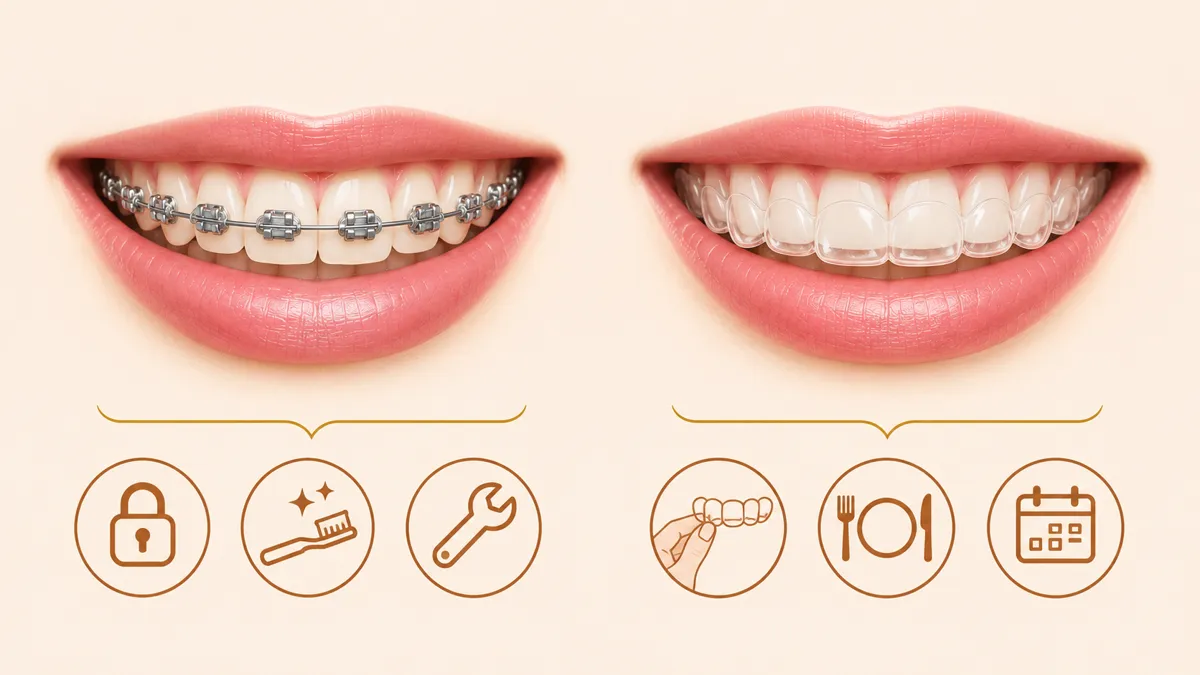
Braces are fixed and need extra cleaning care and regular adjustments. Invisalign aligners are removable, so you can eat normally, and are changed on a schedule.
Bite correction is harder still. A 2025 systematic review of deep bite treatment with aligners found the bite opened by 0.4 to 3.8 mm, with accuracy of 33% to 49% of what was planned [6]. Pushing the lower front teeth up into the bone, one of the main ways a deep bite is corrected, achieved 0.4 to 1.5 mm with predictability of 35% to 65% [16]. Moving upper molars backwards along the arch, a 2025 review found predictability of 61.1% [17]. A 2026 review of why patients need a second round of aligners listed rotations, intrusion, vertical movements, widening the arch and selected front-tooth movements as the least predictable [7].
None of this means aligners fail. It means the plan has to allow for the shortfall, and someone has to notice when a tooth is not following the plastic. That is what I mean by control.
Why I do not pick a winner
The case, the movements, compliance, the bite and the treatment goals decide which appliance gives me the control I need.
The case. An extraction case and a non-extraction case are different problems, and the evidence says the appliances perform differently in each [2].
The movements. If the plan needs a large rotation of a canine, a lot of bite opening, or a tooth brought down into the arch, the evidence above tells me where aligners struggle [5, 6, 13, 16]. If the plan is mostly mild alignment, both do well.
Compliance. An aligner that sits in a drawer moves nothing. Braces work whether or not the patient remembers them. Some patients know themselves well enough to choose braces for that reason alone, and I respect that.
The bite and the goals. A plan that sets out to finish a bite to a high standard is held to the measures in the research above. A plan whose goal is to tidy six front teeth is not. The goal defines the tool.
I do not choose a winner between braces and Invisalign. I choose the appliance that executes the plan. In some cases that is aligners. In some it is braces. In a few, it is both, at different stages. The patient’s preference matters, and I will always try to honour it, but I will tell them plainly when the preferred appliance would cost them control.
What this means for you
- Decide what “better” means to you before you decide on an appliance. Visibility, comfort, speed and finish quality are different things, and the evidence treats them differently.
- Ask what movements your plan needs. That, more than the brand, decides whether aligners will deliver.
- If a simulation shows you a finished result, remember that on average the teeth deliver about half of what the software shows [3, 4].
The appliance is the tool. The plan is the treatment.
Frequently asked questions
Is Invisalign faster than braces?
Not consistently. The largest and most recent comparison found no difference in duration for non-extraction cases [2]. An earlier meta-analysis had found aligner treatment about 6.3 months shorter [9]. Speed depends more on the case and on wearing the aligners than on the appliance itself.
Does Invisalign hurt less than braces?
In the first days, yes. Patients with aligners reported less pain on days 3 and 4 after starting, according to a 2023 meta-analysis [1]. Both appliances cause some discomfort when teeth move.
Can Invisalign fix a deep bite or a badly rotated tooth?
Sometimes, but these are the movements where aligners are least predictable. Deep bite correction achieved 33% to 49% of what was planned [6], and canine rotation about 48% [5]. Whether that is enough for your case is a specialist judgement made from your records.
How is the choice between Invisalign and braces assessed at IB Clinic in Dubai?
At a consultation with Dr Nikhil Sharma at IB Clinic.
Dr Nikhil Sharma is a specialist orthodontist at IB Clinic Dubai (Invisible Braces Dental and Skin Polyclinic) on Sheikh Zayed Road, Trade Centre, Dubai, opposite the Museum of the Future. He treats children and adults with metal, ceramic and Damon braces, Invisalign and lingual braces, including growth modification in children, profile correction in adults without surgery, and orthodontic treatment for cases that need jaw surgery.
Deciding between Invisalign and braces? Have your case assessed properly.
Book a consultation at IB Clinic, Sheikh Zayed Road, Trade Centre, Dubai, opposite the Museum of the Future. Open 7 days, 10 am to 8 pm.
Book a consultation on WhatsApp · Call or WhatsApp 055 529 6155
References
- Li Q, Du Y, Yang K. Comparison of pain intensity and impacts on oral health-related quality of life between orthodontic patients treated with clear aligners and fixed appliances: a systematic review and meta-analysis. BMC Oral Health. 2023;23(1):920. doi:10.1186/s12903-023-03681-w. PMID 38001455.
- Alhafi ZM, Hajeer MY, Alam MK, et al. Quality and stability of orthodontic treatment outcomes with clear aligners versus fixed appliances: a systematic review and meta-analysis. Eur J Orthod. 2025;47(6):cjaf091. doi:10.1093/ejo/cjaf091. PMID 41127933.
- Haouili N, Kravitz ND, Vaid NR, Ferguson DJ, Makki L. Has Invisalign improved? A prospective follow-up study on the efficacy of tooth movement with Invisalign. Am J Orthod Dentofacial Orthop. 2020;158(3):420-5. doi:10.1016/j.ajodo.2019.12.015. PMID 32620479.
- Kravitz ND, Kusnoto B, BeGole E, Obrez A, Agran B. How well does Invisalign work? Am J Orthod Dentofacial Orthop. 2009;135(1):27-35. doi:10.1016/j.ajodo.2007.05.018. PMID 19121497.
- Koletsi D, Iliadi A, Eliades T. Predictability of rotational tooth movement with orthodontic aligners comparing software-based and achieved data: a systematic review and meta-analysis. J Orthod. 2021;48(3):277-87. doi:10.1177/14653125211027266. PMID 34176358.
- Husain F, Riccardi J, Alletto L, et al. Effectiveness and accuracy of clear aligners in treatment of deep bite: a systematic review. Clin Oral Investig. 2025;29(6):306. doi:10.1007/s00784-025-06381-7. PMID 40394411.
- Nogueira Matos K, Belline da Silva T, Matos de Faria Almeida L, et al. Clinical, biomechanical, and digital factors associated with refinement after the first series of clear aligners: a systematic review. Int Orthod. 2026;24(4):101211. doi:10.1016/j.ortho.2026.101211. PMID 42442043.
- Papageorgiou SN, Koletsi D, Iliadi A, Peltomaki T, Eliades T. Treatment outcome with orthodontic aligners and fixed appliances: a systematic review with meta-analyses. Eur J Orthod. 2020;42(3):331-43. doi:10.1093/ejo/cjz094. PMID 31758191.
- Ke Y, Zhu Y, Zhu M. A comparison of treatment effectiveness between clear aligner and fixed appliance therapies. BMC Oral Health. 2019;19(1):24. doi:10.1186/s12903-018-0695-z. PMID 30674307.
- Alhuwaizi MA, Saloom HF, Cobourne M. Impact of clear aligners and conventional fixed orthodontic appliances on oral hygiene and periodontal health: a systematic review with GRADE assessment. Eur J Orthod. 2026;48(3):cjaf100. doi:10.1093/ejo/cjaf100. PMID 42163541.
- Kreuter P, Sára Haba K, Kiss-Dala S, et al. Root resorption caused by aligners, self-ligating appliances, and conventional fixed appliances: a CBCT-based meta-analysis. BMC Oral Health. 2025;25(1):1259. doi:10.1186/s12903-025-06639-2. PMID 40713565.
- Robertson L, Kaur H, Fagundes NCF, et al. Effectiveness of clear aligner therapy for orthodontic treatment: a systematic review. Orthod Craniofac Res. 2020;23(2):133-42. doi:10.1111/ocr.12353. PMID 31651082.
- Rossini G, Parrini S, Castroflorio T, Deregibus A, Debernardi CL. Efficacy of clear aligners in controlling orthodontic tooth movement: a systematic review. Angle Orthod. 2015;85(5):881-9. doi:10.2319/061614-436.1. PMID 25412265.
- Castroflorio T, Sedran A, Parrini S, et al. Predictability of orthodontic tooth movement with aligners: effect of treatment design. Prog Orthod. 2023;24(1):2. doi:10.1186/s40510-022-00453-0. PMID 36642743.
- Benedetti G, Sicca N, Lopponi G, et al. Evaluating the clinical success of clear aligners for rotational tooth movements in adult patients: a systematic review. Dent J (Basel). 2025;13(10):440. doi:10.3390/dj13100440. PMID 41149087.
- Fracchia DE, Bignotti D, Lai S, et al. Predictability of lower incisor intrusion with clear aligners: a systematic review. J Clin Med. 2025;14(17):6339. doi:10.3390/jcm14176339. PMID 40944102.
- García-Marín C, Otero-Pregigueiro A, Iglesias-Linares A. Predictability of mesiodistal movement of upper and lower molars with clear aligners: a systematic review. Angle Orthod. 2025;95(5):563-71. doi:10.2319/063024-507.1. PMID 40936630.


0 Comments