By Dr Nikhil Sharma, Specialist Orthodontist at IB Clinic Dubai (Invisible Braces Dental and Skin Polyclinic), Sheikh Zayed Road, Trade Centre, Dubai
Short answer
I would refuse to answer until I had seen my own records. If both appliances could deliver the same result, I would choose on lifestyle, visibility and compliance, and often that is fair: a 2025 meta-analysis of 15 trials and 1,084 patients found no difference in result quality or treatment time between aligners and braces in non-extraction cases, but braces were superior when teeth had to be removed (Alhafi et al., 2025 [1]). If one appliance gave me materially better control of the movements I needed, I would choose control over convenience. A Dubai study of Invisalign found teeth moved on average only 50% of the way the software planned [4]. The records decide, not the brand.
Key points
- For many non-extraction cases, aligners and braces give the same quality of result in the same time [1].
- In extraction cases braces come out ahead [1], and aligners score worse on occlusal finish overall [2].
- Aligner accuracy is about 50%: the teeth follow roughly half the planned movement [4, 5].
- Rotations, bite opening and intrusion are the movements aligners deliver least reliably [7, 10, 11, 12].
- Comfort and hygiene favour aligners, but only if they are worn and cleaned as prescribed [15, 16].
The full article
Patients in Dubai ask me this in almost every consultation. “If you had to choose braces or Invisalign for yourself, which one?”
My honest answer disappoints people at first. I would refuse to answer until I saw my own records. Not because I am dodging the question, but because the question has no answer without them. I am loyal to the treatment objective, not the appliance.
Would I choose Invisalign or braces for myself?
I would choose whichever appliance gave me the result I wanted with the least compromise. That depends on three things: what movements my teeth need, how much control each appliance gives me over those movements, and how I would live with the appliance for a year or more.
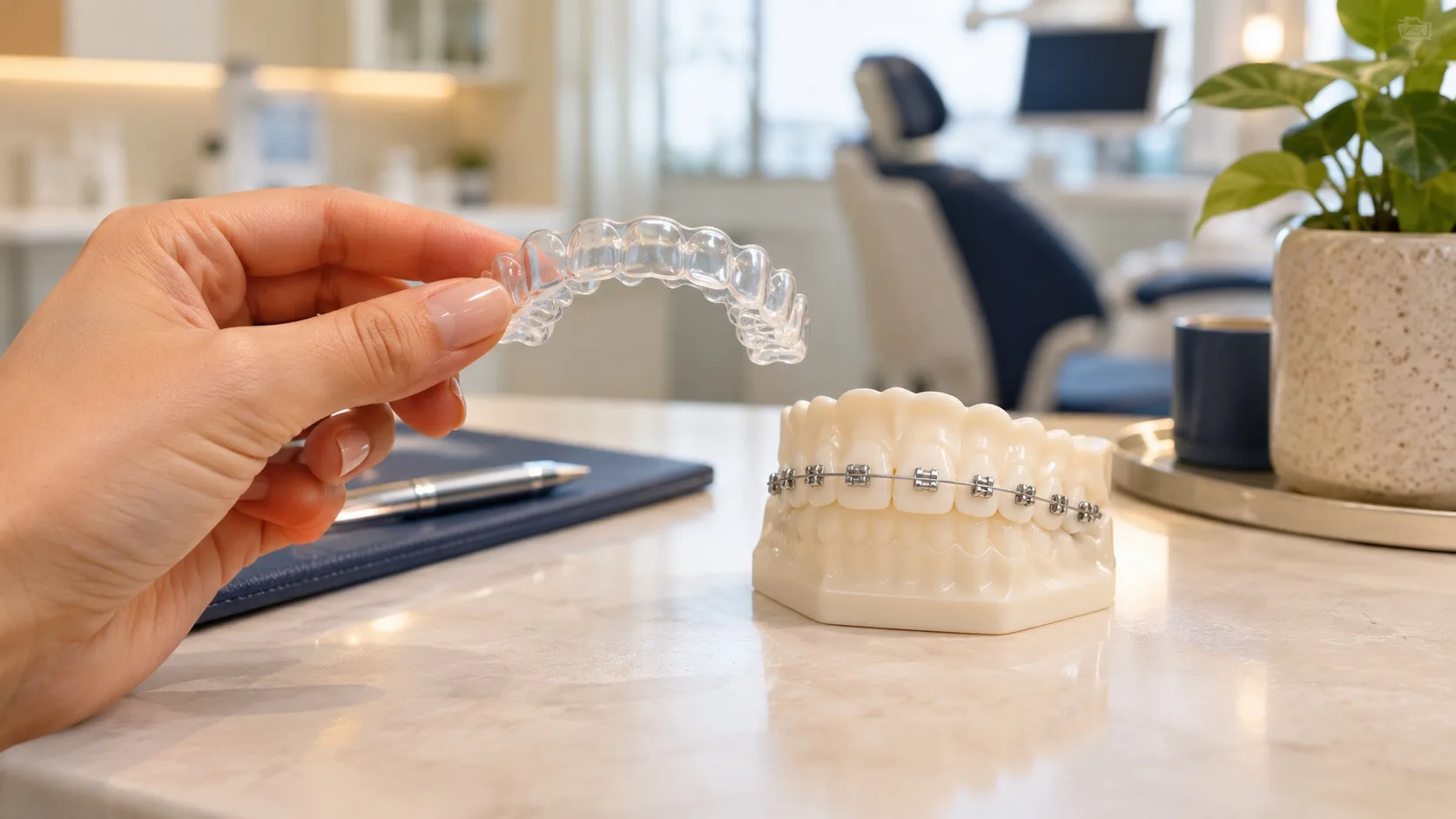
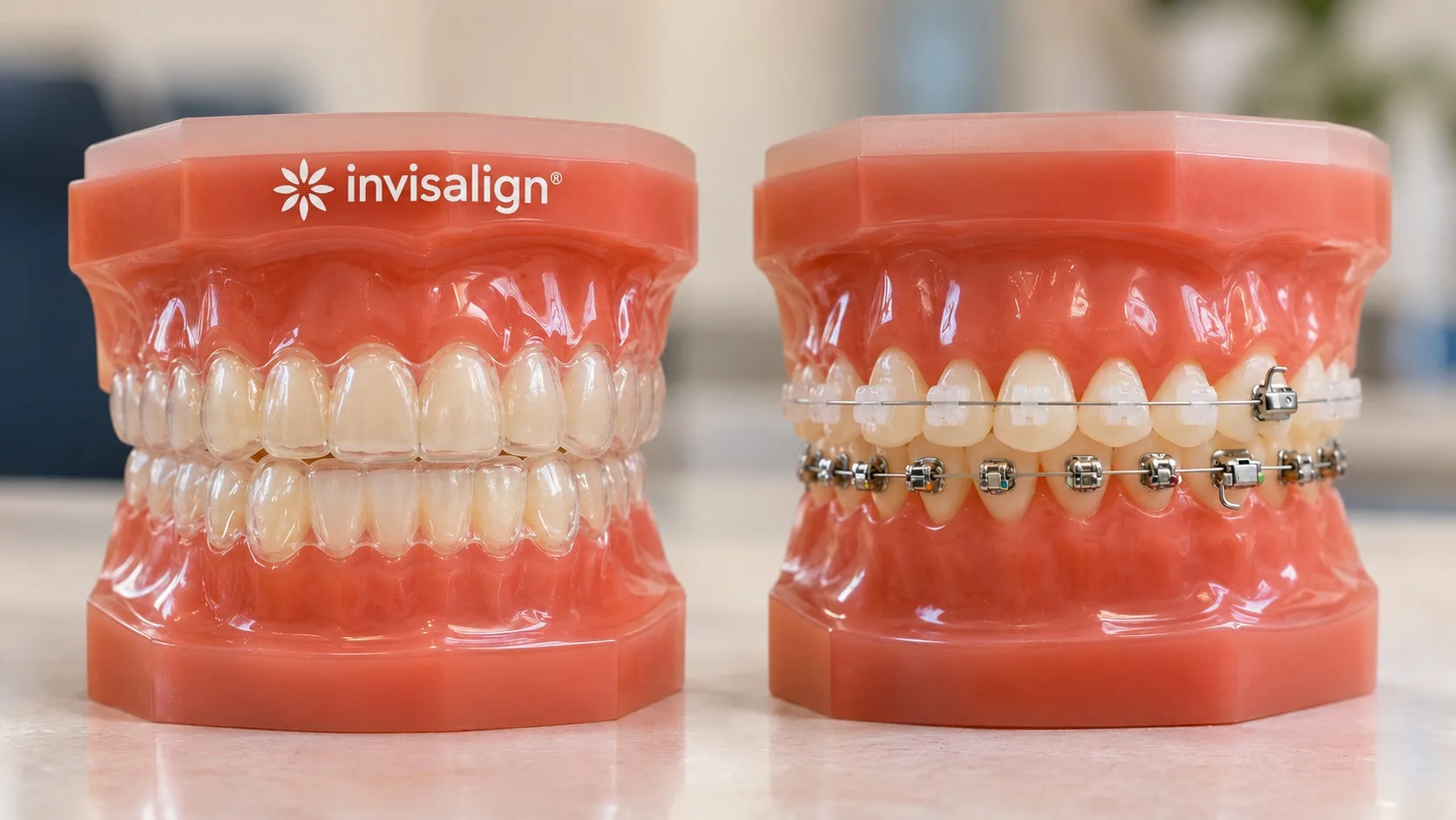
If both could deliver the same quality of result, I would choose on lifestyle, visibility and compliance. For a lot of cases, that is exactly the position the research supports. A 2025 meta-analysis of 15 trials and 1,084 patients found no difference in result quality or treatment duration between clear aligners and fixed braces when no teeth were extracted [1]. In those cases the choice is genuinely mine to make on comfort and appearance, and I would make it without guilt.
If one appliance gave me materially better control for the movements I needed, I would choose control over convenience. The same 2025 meta-analysis found that in extraction cases, fixed braces produced better results than aligners [1]. An earlier 2020 meta-analysis, pooling cases of all types, found aligner cases scored on average 9.9 points worse on the American Board of Orthodontics occlusal index and were 1.6 times more likely to be rated unacceptable, though the authors graded the evidence as moderate quality [2]. For the record, the same body of evidence shows aligners finish faster on average, by about six months in one meta-analysis [3]. Speed is not the same as control, and I would not trade a compromised finish for a shorter calendar.
So the real question is never “which is better”. It is “which one executes my plan”.
What the records tell me that the mirror cannot
The reason I insist on records is that the difficulty of a case is not visible from the outside. A case that looks dramatic can be mechanically straightforward. A case that looks mild can contain one movement that is difficult to express with a particular appliance.
For aligners, the honest figure is about half. A Dubai study published in 2020 followed Invisalign patients prospectively and found that the mean accuracy of tooth movement, how far the teeth actually moved compared with what the software planned, was 50% [4]. That was an improvement on the 41% reported in the original 2009 study of the same question [5]. A 2020 systematic review concluded that most tooth movements are not predictable enough to be finished with a single set of aligners [6], which is why refinement series are routine, not a sign that something went wrong.
The 50% is an average, and the average hides the detail I care about.
- Rotations. A 2021 meta-analysis found that rotating an upper canine with aligners achieved 47.9% of what was planned [7]. Round-crowned teeth such as canines and lower premolars are worst: a 2023 study found they rotated about 0.4 degrees for every degree prescribed, and the attachments designed to help “seem not working properly” on those teeth [8]. A 2025 review confirmed canines and premolars are the least reliable teeth to rotate with aligners [9].
- Extrusion. Pulling a tooth down, or up, into the line is the least accurate aligner movement of all, at around 30% in a 2015 review [10].
- Bite opening. Correcting a deep bite with aligners opened the bite by 0.4 to 3.8 mm with accuracy of 33% to 49% in a 2025 review [11]. Intrusion of the lower front teeth, the movement most deep bites need, was 35% to 65% predictable in another 2025 review [12].
- Moving back teeth. Pushing an upper molar backwards was 61.1% predictable in a 2025 review [13], which is better than the movements above, and still not the whole way.
A 2026 systematic review of what drives the need for refinement found the same list: rotations, intrusion, vertical and transverse changes and selected front-tooth movements are the ones aligners deliver least predictably [14].
If my own case needed one of those harder movements, I would expect aligners alone to deliver only part of it in the first series. If it needed mild alignment with no bite change, aligners could do it as well as braces, and I would pick the one I could live with.
What aligners do better
None of this means braces win. The things aligners do better are real, and they matter to me as a patient as much as to anyone.
- Comfort. A 2023 meta-analysis found less pain with aligners than with fixed braces on days three and four [15].
- Hygiene. A 2026 systematic review found that the oral hygiene and gum health advantage of aligners depends on compliance. The advantage is there for the patient who cleans the aligners and the teeth as instructed [16].
- Root safety. Patients sometimes worry that one appliance is harsher on the roots. A 2025 CBCT meta-analysis found no significant difference in root resorption between aligners, self-ligating braces and conventional braces, and the amounts in all three groups were under 1 mm and not clinically relevant [17].
- Visibility and removability. Aligners are nearly invisible and come out for meals and photographs. That is an obvious advantage, and for an adult with a public-facing job in Dubai it is often the deciding one, provided the plan does not need control the aligner cannot give.
Compliance is the hinge. Aligners only work in the mouth. Every figure above assumes the aligner is worn as prescribed. If I knew I would take them out and forget them, I would choose a fixed appliance for myself and accept the trade.
The third option most patients forget
Invisible orthodontics is not one product. Lingual braces are fixed braces bonded behind the teeth, so they are invisible from the front and give me the control of a fixed appliance. In adults, lingual and conventional braces produced similar improvements in bite scores in a 2019 study [18], and a 2026 cohort study found comparable results, with lingual treatment taking longer [19].
The trade is adaptation. A 2013 study found lingual patients were far more likely to report tongue pain, with an odds ratio of 32, and about eight times more likely to report speech difficulty [20]. If my own case needed fixed-appliance control and I did not want visible brackets, lingual braces would be on my list, with my eyes open about the first few weeks.
So which would I choose?
The one my own case needs. If both would give the same result, the one I could live with. That is the same standard I use for patients.
Frequently asked questions
Is Invisalign as good as braces?
For many non-extraction cases, yes: a 2025 meta-analysis of 15 trials found no difference in quality of result or treatment time [1]. For extraction cases and for some specific movements, braces give better control [1, 2]. Which applies to you is decided from your records.
Why did my aligner treatment need extra trays?
Because aligners deliver about half of the planned movement on average [4, 5], and most movements are not predictable enough to finish with one series [6]. A refinement series is part of the method, not a failure. Rotations, intrusion and bite changes are the movements most likely to need it [14].
Are lingual braces better than Invisalign?
They solve the same visibility problem in completely different ways. Lingual braces are fixed, so they give fixed-appliance control and produce results comparable to conventional braces [18, 19], but they take more getting used to, with more tongue discomfort and speech difficulty [20]. Aligners are removable and more comfortable but depend on wear time. The right one depends on the movements your case needs.
How is the choice between Invisalign and braces assessed at IB Clinic Dubai?
At a consultation with Dr Nikhil Sharma. The appliance is chosen after the plan is made, not before.
Dr Nikhil Sharma is a specialist orthodontist at IB Clinic Dubai (Invisible Braces Dental and Skin Polyclinic) on Sheikh Zayed Road, Trade Centre, Dubai, opposite the Museum of the Future. He treats children and adults with metal, ceramic and Damon braces, Invisalign and lingual braces, including growth modification in children, profile correction in adults without surgery, and orthodontic treatment for cases that need jaw surgery.
Invisalign or braces? Let the records decide.
Book a consultation at IB Clinic, Sheikh Zayed Road, Trade Centre, Dubai, opposite the Museum of the Future. Open 7 days, 10 am to 8 pm.
Book a consultation on WhatsApp · Call or WhatsApp 055 529 6155
References
- Alhafi ZM, Hajeer MY, Alam MK, et al. Quality and stability of orthodontic treatment outcomes with clear aligners versus fixed appliances: a systematic review and meta-analysis. Eur J Orthod. 2025;47(6):cjaf091. doi:10.1093/ejo/cjaf091. PMID 41127933.
- Papageorgiou SN, Koletsi D, Iliadi A, Peltomaki T, Eliades T. Treatment outcome with orthodontic aligners and fixed appliances: a systematic review with meta-analyses. Eur J Orthod. 2020;42(3):331-43. doi:10.1093/ejo/cjz094. PMID 31758191.
- Ke Y, Zhu Y, Zhu M. A comparison of treatment effectiveness between clear aligner and fixed appliance therapies. BMC Oral Health. 2019;19(1):24. doi:10.1186/s12903-018-0695-z. PMID 30674307.
- Haouili N, Kravitz ND, Vaid NR, Ferguson DJ, Makki L. Has Invisalign improved? A prospective follow-up study on the efficacy of tooth movement with Invisalign. Am J Orthod Dentofacial Orthop. 2020;158(3):420-5. doi:10.1016/j.ajodo.2019.12.015. PMID 32620479.
- Kravitz ND, Kusnoto B, BeGole E, Obrez A, Agran B. How well does Invisalign work? Am J Orthod Dentofacial Orthop. 2009;135(1):27-35. doi:10.1016/j.ajodo.2007.05.018. PMID 19121497.
- Robertson L, Kaur H, Fagundes NCF, et al. Effectiveness of clear aligner therapy for orthodontic treatment: a systematic review. Orthod Craniofac Res. 2020;23(2):133-42. doi:10.1111/ocr.12353. PMID 31651082.
- Koletsi D, Iliadi A, Eliades T. Predictability of rotational tooth movement with orthodontic aligners comparing software-based and achieved data: a systematic review and meta-analysis. J Orthod. 2021;48(3):277-87. doi:10.1177/14653125211027266. PMID 34176358.
- Castroflorio T, Sedran A, Parrini S, et al. Predictability of orthodontic tooth movement with aligners: effect of treatment design. Prog Orthod. 2023;24(1):2. doi:10.1186/s40510-022-00453-0. PMID 36642743.
- Benedetti G, Sicca N, Lopponi G, et al. Evaluating the clinical success of clear aligners for rotational tooth movements in adult patients: a systematic review. Dent J (Basel). 2025;13(10):440. doi:10.3390/dj13100440. PMID 41149087.
- Rossini G, Parrini S, Castroflorio T, Deregibus A, Debernardi CL. Efficacy of clear aligners in controlling orthodontic tooth movement: a systematic review. Angle Orthod. 2015;85(5):881-9. doi:10.2319/061614-436.1. PMID 25412265.
- Husain F, Riccardi J, Alletto L, et al. Effectiveness and accuracy of clear aligners in treatment of deep bite: a systematic review. Clin Oral Investig. 2025;29(6):306. doi:10.1007/s00784-025-06381-7. PMID 40394411.
- Fracchia DE, Bignotti D, Lai S, et al. Predictability of lower incisor intrusion with clear aligners: a systematic review. J Clin Med. 2025;14(17):6339. doi:10.3390/jcm14176339. PMID 40944102.
- García-Marín C, Otero-Pregigueiro A, Iglesias-Linares A. Predictability of mesiodistal movement of upper and lower molars with clear aligners: a systematic review. Angle Orthod. 2025;95(5):563-71. doi:10.2319/063024-507.1. PMID 40936630.
- Nogueira Matos K, Belline da Silva T, Matos de Faria Almeida L, et al. Clinical, biomechanical, and digital factors associated with refinement after the first series of clear aligners: a systematic review. Int Orthod. 2026;24(4):101211. doi:10.1016/j.ortho.2026.101211. PMID 42442043.
- Li Q, Du Y, Yang K. Comparison of pain intensity and impacts on oral health-related quality of life between orthodontic patients treated with clear aligners and fixed appliances: a systematic review and meta-analysis. BMC Oral Health. 2023;23(1):920. doi:10.1186/s12903-023-03681-w. PMID 38001455.
- Alhuwaizi MA, Saloom HF, Cobourne M. Impact of clear aligners and conventional fixed orthodontic appliances on oral hygiene and periodontal health: a systematic review with GRADE assessment. Eur J Orthod. 2026;48(3):cjaf100. doi:10.1093/ejo/cjaf100. PMID 42163541.
- Kreuter P, Sára Haba K, Kiss-Dala S, et al. Root resorption caused by aligners, self-ligating appliances, and conventional fixed appliances: a CBCT-based meta-analysis. BMC Oral Health. 2025;25(1):1259. doi:10.1186/s12903-025-06639-2. PMID 40713565.
- Ata-Ali F, Plasencia E, Lanuza-Garcia A, Ferrer-Molina M, Melo M, Ata-Ali J. Effectiveness of lingual versus labial fixed appliances in adults according to the Peer Assessment Rating index. Am J Orthod Dentofacial Orthop. 2019;155(6):819-25. doi:10.1016/j.ajodo.2018.07.018. PMID 31153502.
- Nguyen VA, Nguyen TT, Vo TNN, et al. Clinical outcomes of digital straightwire lingual versus labial fixed appliances assessed with American Board of Orthodontics indices: a retrospective cohort study. Clin Oral Investig. 2026;30(3):108. doi:10.1007/s00784-026-06804-z. PMID 41790284.
- Long H, Zhou Y, Pyakurel U, et al. Comparison of adverse effects between lingual and labial orthodontic treatment. Angle Orthod. 2013;83(6):1066-73. doi:10.2319/010113-2.1. PMID 23581503.



0 Comments