
By Dr Nikhil Sharma, Specialist Orthodontist at IB Clinic Dubai (Invisible Braces Dental and Skin Polyclinic), Sheikh Zayed Road, Trade Centre, Dubai
Short answer
Because your mouth does not stop changing when the braces come off. The bone and gum fibres around a moved tooth take months to settle, the bite keeps adjusting, and the lips, cheeks and tongue press on the teeth for the rest of your life. Even people who never had braces get more crowded lower front teeth from their teens into their sixties (Basim et al., 2026 [1]). In the longest follow-up of treated patients, only 10% still had acceptably straight lower front teeth 10 to 20 years after retainers were stopped (Little et al., 1988 [2]). That is why retainers are part of orthodontic treatment, not an optional souvenir. In Dubai, I discuss retention at the first consultation.
Key points
- Teeth keep moving throughout life, treated or not. Lower front teeth crowd more at every age, 13 to 62 [1].
- Without retainers, only 10% of treated patients kept acceptable alignment 10 to 20 years later [2].
- Orthodontists are advised to treat every patient as having high relapse potential [3].
- No retainer type clearly wins. The 2023 Cochrane review of 47 studies could not pick one [9].
- Retainers break and wear out. Bonded retainers fail in about a third of patients, so checks matter [12].
The full article
A patient tells me in a first consultation in Dubai that they had braces as a teenager and the teeth are crooked again. The first question is always what went wrong. Usually nothing went wrong. Something very ordinary happened, and nobody explained it at the time.
Why do teeth shift back after braces?
Your teeth do not know treatment is finished when the braces come off. The tissues around the teeth continue remodelling, the bite settles, and forces from the lips, cheeks and tongue continue throughout life. None of those processes read the treatment plan.
Orthodontists have known this for a long time. The standard advice in the specialty is to treat every patient as having a high potential for relapse, because we cannot reliably predict in advance whose teeth will stay put and whose will not [3]. Moving teeth creates the result. Retention helps protect it.
What happens in the months after the braces come off
A tooth sits in a socket of bone, held by thousands of tiny fibres in the gum and in the ligament around the root. When a tooth is moved, bone is removed on one side of the root and new bone is laid down on the other, and the fibres are stretched. In my practice I describe it to patients as a tent peg moved to new ground. The soil has to firm up around it before it holds on its own, and until then the guy ropes keep pulling.
That settling takes time. In the early months the fibres are still under tension and the new bone is still immature, so the tooth has a tendency to drift back towards where it came from. The bite settles too, as the upper and lower teeth find their new contacts. This is the period in which a retainer is doing its most obvious work.
Teeth move for the rest of your life, with or without braces
Most patients have never heard this. Teeth that were never treated move as well.
Following adults with normal, untreated bites from age 25 to 46, the lips became more retruded relative to the nose and chin, and the crowding of the front teeth increased [4]. From late adolescence into the late fifties, the upper lip thins and lengthens and the nose tip drops [5]. In a 50-year study of people with perfect bites who never had treatment, the lower front teeth became more crowded at every interval from 13 to 62 [1]. A separate 40-year follow-up found the same steady narrowing of the dental arch through adult life [6].
So “my teeth moved after braces” is partly “my teeth moved because I got older”. A retainer is what holds the front teeth against that drift.
The amount of crowding you started with does not protect you either. Over 37 years of follow-up, it was the mildly crowded cases that relapsed proportionally more, not the severe ones [7]. A small, easy-looking case still needs retention.
What the long-term studies show about relapse
The classic study in this area followed patients for 10 to 20 years after they stopped wearing retainers. At the final records, only 10% still had lower front teeth that would be judged clinically acceptable in alignment [2]. The rest had relapsed to some degree. Alignment in these studies is measured with Little’s irregularity index, which adds up how far each front tooth is displaced from its neighbour [8].
Ninety per cent is not a sign that the treatment failed. It is a sign that teeth, left unsupported, go on doing what untreated teeth do.
Retainers: what the research can and cannot tell us
Patients ask me which retainer they should have. The honest answer is that the research does not settle it.
A 2023 Cochrane review of 47 studies and 4,377 participants found the evidence to be of low or very low certainty and could not draw a firm conclusion that any one retention approach is better than another [9]. That is not a reason to skip retainers. It is a reason to choose the retainer for the person in front of me rather than from a league table.
The individual trials are still useful. In a five-year randomised trial comparing clear removable retainers with fixed bonded wires, the lower front teeth drifted by 0.6 mm with the removable retainer and 0.1 mm with the bonded one [10]. A 2024 meta-analysis found the two types similar in holding arch shape and alignment overall. Fixed retainers were statistically better for the lower front teeth, but the difference was too small to matter clinically [11].
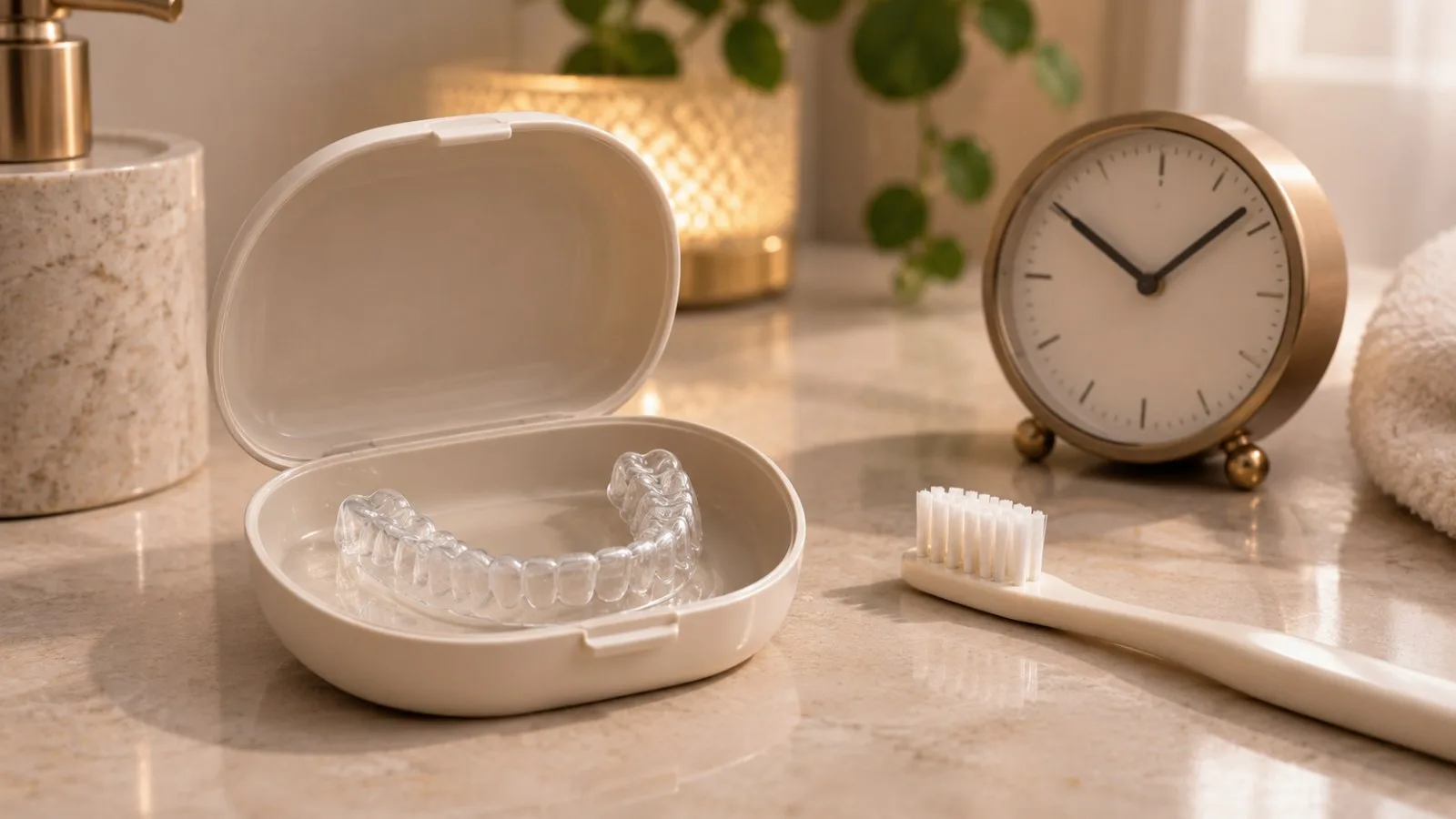
The bigger problem is that retainers break. A 2023 meta-analysis found that bonded retainers fail in 35.2% of patients [12]. In a 2025 randomised trial, clear removable retainers failed in 60.9% of patients, against 20.8% and 34.8% for two bonded designs [13]. A retainer that has broken, cracked or stopped fitting is not retaining anything, and the teeth begin to move as soon as it stops working.
What this means if your treatment is finishing
- Expect retainers for the long term. In my practice the plan is wear in some form for as long as you want the teeth to stay where they are, reducing in hours over time but not stopping, because the forces that move teeth do not stop.
- Treat the retainer as part of the treatment. The result you invested in is protected by it.
- Have it checked. A bonded wire can come loose from one tooth without you noticing, and a removable retainer can crack or distort. If it is lost or broken, the sooner it is replaced, the less the teeth will have moved.
- If your teeth have already shifted years after braces, that is common and it can be assessed. Sometimes a new retainer is enough. Sometimes some treatment is needed before a retainer will hold anything worth holding. The records decide.
Frequently asked questions
How long do I need to wear retainers after braces?
Longer than most people expect. Teeth continue to move through adult life whether or not they were treated [1, 4, 6], and the specialty’s advice is to treat everyone as high relapse risk [3]. In my practice I plan for long-term wear, usually reducing to nights only after the first period, and I review the retainer at check-ups.
My retainer broke. Does it matter if I leave it for a few months?
Yes. Bonded retainers fail in about a third of patients, and removable ones failed more often in one trial [12, 13], and the teeth start to drift as soon as the retainer stops holding them. Contact your orthodontist and have it repaired or replaced promptly.
Can teeth shift years after braces even if I wore my retainer?
Some change is normal. Even with a bonded wire, the lower front teeth moved a small amount over five years in a randomised trial [10], and the face and the arches keep changing with age [4, 5, 6]. The aim of retention is to keep that change small, not to freeze the teeth forever.
How is retention assessed at IB Clinic Dubai?
At a check-up with Dr Nikhil Sharma, who compares your teeth with where they finished.
Dr Nikhil Sharma is a specialist orthodontist at IB Clinic Dubai (Invisible Braces Dental and Skin Polyclinic) on Sheikh Zayed Road, Trade Centre, Dubai, opposite the Museum of the Future. He treats children and adults with metal, ceramic and Damon braces, Invisalign and lingual braces, including growth modification in children, profile correction in adults without surgery, and orthodontic treatment for cases that need jaw surgery.
Teeth shifting after braces? Have them assessed properly.
Book a consultation at IB Clinic, Sheikh Zayed Road, Trade Centre, Dubai, opposite the Museum of the Future. Open 7 days, 10 am to 8 pm.
Book a consultation on WhatsApp · Call or WhatsApp 055 529 6155
References
- Basim A, Naoumova J, Leffler K, et al. Digital analysis of age-related dentoalveolar changes: a 50-year longitudinal study. Prog Orthod. 2026;27(1):41. doi:10.1186/s40510-026-00643-0. PMID 42726424.
- Little RM, Riedel RA, Artun J. An evaluation of changes in mandibular anterior alignment from 10 to 20 years postretention. Am J Orthod Dentofacial Orthop. 1988;93(5):423-8. doi:10.1016/0889-5406(88)90102-3. PMID 3163221.
- Littlewood SJ, Kandasamy S, Huang G. Retention and relapse in clinical practice. Aust Dent J. 2017;62 Suppl 1:51-7. doi:10.1111/adj.12475. PMID 28297088.
- Bishara SE, Treder JE, Jakobsen JR. Facial and dental changes in adulthood. Am J Orthod Dentofacial Orthop. 1994;106(2):175-86. doi:10.1016/S0889-5406(94)70036-2. PMID 8059754.
- Pecora NG, Baccetti T, McNamara JA Jr. The aging craniofacial complex: a longitudinal cephalometric study from late adolescence to late adulthood. Am J Orthod Dentofacial Orthop. 2008;134(4):496-505. doi:10.1016/j.ajodo.2006.11.022. PMID 18929267.
- Tsiopas N, Nilner M, Bondemark L, Bjerklin K. A 40 years follow-up of dental arch dimensions and incisor irregularity in adults. Eur J Orthod. 2013;35(2):230-5. doi:10.1093/ejo/cjr121. PMID 22015823.
- Gambardela-Tkacz CM, Alcaraz G, Cotrin P, et al. Incisor irregularity and dental arch dimensions changes in subjects with different severity of anterior crowding: a 37-year follow-up. Prog Orthod. 2023;24(1):10. doi:10.1186/s40510-023-00461-8. PMID 36935470.
- Little RM. The irregularity index: a quantitative score of mandibular anterior alignment. Am J Orthod. 1975;68(5):554-63. doi:10.1016/0002-9416(75)90086-x. PMID 1059332.
- Martin C, Littlewood SJ, Millett DT, et al. Retention procedures for stabilising tooth position after treatment with orthodontic braces. Cochrane Database Syst Rev. 2023;5(5):CD002283. doi:10.1002/14651858.CD002283.pub5. PMID 37219527.
- Krämer A, Sjöström M, Apelthun C, Hallman M, Feldmann I. Post-treatment stability after 5 years of retention with vacuum-formed and bonded retainers — a randomized controlled trial. Eur J Orthod. 2023;45(1):68-78. doi:10.1093/ejo/cjac043. PMID 35968668.
- Hussain U, Kunwar SS, Khan UW, et al. Can vacuum-formed retainers maintain arch dimensions and alignment compared to Hawley and fixed bonded retainers? A systematic review and meta-analysis. Eur J Orthod. 2024;46(5):cjae040. doi:10.1093/ejo/cjae040. PMID 39177154.
- Aye ST, Liu S, Byrne E, El-Angbawi A. The prevalence of the failure of fixed orthodontic bonded retainers: a systematic review and meta-analysis. Eur J Orthod. 2023;45(6):645-61. doi:10.1093/ejo/cjad047. PMID 37824794.
- Al-Hudaid KN, Al-Nimri KS, Al-Qaqaa SM. Comparison of treatment stability among maxillary round multi-strand wire, chairside rectangular chain and vacuum formed retainers: a randomized clinical trial. Angle Orthod. 2025;96(1):53-9. doi:10.2319/022025-150.1. PMID 41005762.


0 Comments