By Dr Nikhil Sharma, Specialist Orthodontist at IB Clinic Dubai (Invisible Braces Dental and Skin Polyclinic), Sheikh Zayed Road, Trade Centre, Dubai
Short answer
Around age 7. That first visit is an assessment, not the start of braces, and assessment does not mean treatment. Most findings in a young child are monitored: about 1 in 10 children have a back-teeth crossbite in the baby teeth and it corrects itself in roughly three out of four (Khda et al., 2023 [1]). Some findings matter during growth. A 2018 Cochrane review found treating prominent front teeth early cut new injuries to those teeth from 30% to 19% [2], and an upper canine that cannot be felt by age 11 is a warning sign [3]. Often the decision at a first visit is simply to review at the right interval.
Key points
- Early assessment is not early treatment. Many findings in young children are monitored and resolve alone [1, 4].
- Early treatment of prominent front teeth has no long-term advantage over starting at 12, except fewer injuries [2, 5, 6].
- Crossbites with a jaw shift, ectopic teeth and some jaw discrepancies can matter during growth [7, 8].
- An upper canine that cannot be felt by 11 needs an X-ray; waiting can cost neighbouring roots [3, 9].
- The mistake is not waiting. The mistake is waiting without knowing what you are waiting for.
The full article
Parents in Dubai ask me this in two opposite ways. One asks, “Is it too early for braces? He is only seven.” The other asks, “Should I have brought her in sooner? She is twelve and all her adult teeth are in.”
Both are asking the same question underneath. When should a child first see an orthodontist, and does seeing one mean treatment?
Is it too early for braces?
Usually, yes. Is it too early for an assessment? Usually, no.
Those are two different questions, and confusing them is why some children are treated too soon and others are seen too late. Early assessment is not the same as early treatment. Sometimes my decision after a first visit is simply: monitor this child and review at the right interval. That is a decision, made from records, with a reason behind it.
The American Association of Orthodontists recommends a first orthodontic check by age 7, when the first adult molars and front teeth have come through and the pattern of the bite can be seen. The purpose of that visit is to find the small number of children whose timing matters, not to put braces on seven-year-olds.
Most of what I see at seven is monitored, not treated
The evidence supports watching. A 2023 study following children from the baby teeth into the mixed dentition found that about 1 in 10 had a posterior crossbite in the baby teeth, and in roughly three out of four it corrected itself without treatment [1]. A 2024 systematic review of the upper first adult molar coming through in the wrong path found that between 47% and 78% of these self-correct by around age 7 [4]. A 2026 study from a Dubai dental hospital found that 4.1% of children aged 5 to 12 had at least one of these ectopic first molars [10], so it is not rare here, and most of those children need a review date, not an appliance.
So when I say “let us see this child again in nine months”, that is not indecision. It is what the research says to do for most findings at this age.
When waiting is not the right answer
A few findings behave differently. They can matter while growth and eruption are still happening, and if they are missed, the options later are narrower.
Crossbites with a jaw shift. A crossbite at the back means an upper tooth closes inside the lower tooth. On its own it is often watched, as above. When the jaw has to slide sideways to close, a functional shift, the child is growing around an asymmetry every day. A 2022 meta-analysis found that correcting a functional crossbite in the mixed dentition widened the upper arch and reduced the lower midline deviation compared with no treatment [7]. A 2025 study found that condylar asymmetry, the difference between the two jaw joints, increased significantly in the period before treatment and not after it [8]. The correction does not hold in everyone: a 2024 meta-analysis put long-term relapse at 19.5% [11]. So this is one finding I do not simply watch, and I give parents the relapse figure as well.
Severe protrusion. Upper front teeth that stick out a long way are the most visible reason parents bring a child in, and the evidence here cuts both ways. The most recent summary, a 2026 umbrella review, concluded that “no clear benefit was observed for early versus late treatment” [5]. The trials behind it say the same. Treating the protrusion early does work: a 2003 multicentre trial found early treatment with a functional appliance reduced overjet and severity [12]. But in the same trial’s follow-up, treatment at 8 or 9 “has no advantages over treatment started at an average age of 12.4 years” once the final result was compared [6], and a separate American trial found that two-phase treatment before adolescence “might be no more clinically effective than 1-phase treatment started during adolescence” [13]. I tell parents this directly. For the average child with prominent teeth, waiting until 11 or 12 gives the same result as starting at 8.
The exception is injury. In a 2018 Cochrane review, 30% of children who waited for later treatment had a new injury to their front teeth, against 19% of those treated early, and early functional appliances reduced the odds of a new injury by just under half [2]. The risk is real: an overjet above 3 mm roughly doubles the chance of injuring a front tooth [14], and a 2015 meta-analysis attributed about 22% of all injuries to front teeth worldwide to a large overjet [15]. So for a child with very prominent teeth who plays contact sport or has already chipped a tooth, timing can matter. That is a judgement from the records and the child, not from a rule.
Ectopic eruption and missing partners. When one adult tooth has come through and its partner on the other side is much later, I want to know why. The textbook convention is that a tooth more than six months behind its partner deserves a look. Sometimes it is a baby tooth that has not fallen out. Sometimes the adult tooth is coming in the wrong direction.
Some jaw discrepancies. Where the upper and lower jaws are growing out of proportion, part of the decision is how much growth is still available. That is a specialist judgement from X-rays and the growth pattern, and once growth is finished some of those options are gone.
The canine that never arrives
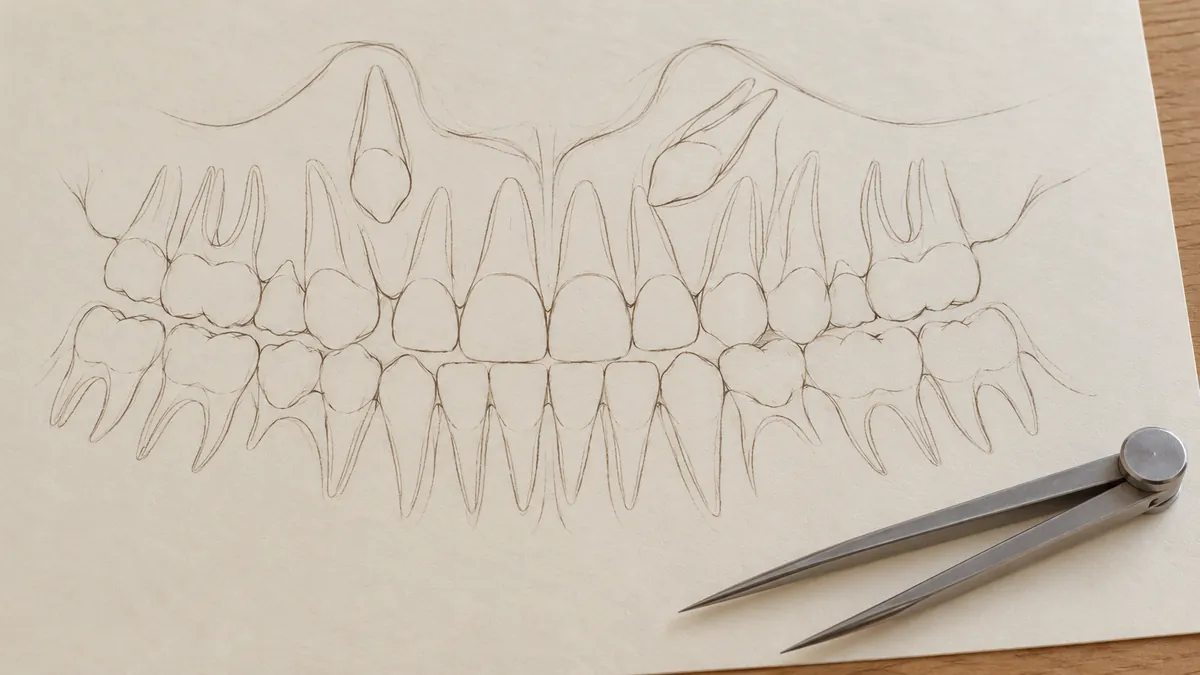
The finding I most dislike seeing late is a stuck upper canine. The upper canines are the last front teeth to come through, and they have the longest journey. In a classic Swedish study, 29% of 10-year-olds had canines that could not yet be felt in the gum on both sides, but by age 11 that had dropped to 5% [3]. A canine that cannot be felt at 11 is in the minority, and the same research group recommended feeling for the canines every year from age 10 for exactly this reason [16].
The reason it matters is the neighbouring teeth. When a canine comes in on the wrong path, it can dissolve the roots of the front teeth next to it. In a CT study, 48% of children with ectopic canines already had resorption of the incisor roots [9]. A 2024 long-term study is more reassuring about what happens once the problem is managed: none of the affected incisors were lost or needed root treatment at follow-up [17]. The sequence is the same in both: find it, then manage it.
Timing changes the options. A 2021 Cochrane review rated the overall evidence for early interventions to help a displaced canine erupt as very uncertain [18], so the decision is made child by child. The strongest single trial, from 2015, found that a simple interceptive step at the right age led to the adult canine erupting on its own in 69% of children, compared with 39% of those left alone [19]. What is not uncertain is that a canine found at 10 or 11 has more options than one found at 15.
What a first visit actually involves
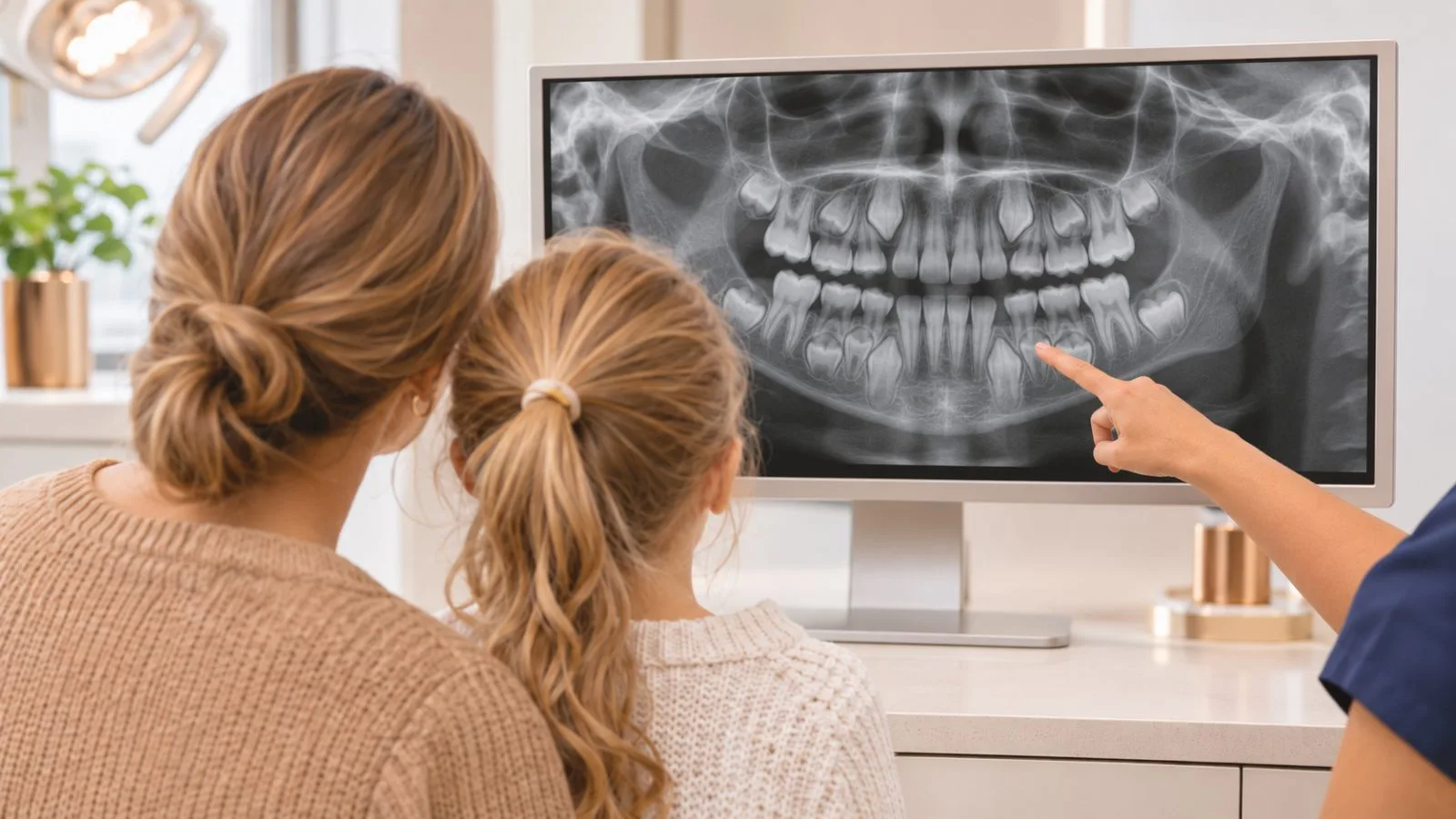
A first orthodontic visit for a child is an assessment. From those records I decide one of three things: nothing needs doing; nothing needs doing now and we review at a set interval; or something needs doing now, and I explain why the timing matters for this child.
Most children leave in the first two groups.
What this means for parents
- Do not wait for all the adult teeth before a first assessment. A check at around 7 finds the few children whose timing matters [2, 3].
- Do not assume an early visit means early braces. Most findings at this age are monitored and many resolve on their own [1, 4].
- For prominent front teeth, early treatment gives the same final result as starting at 12 [5, 6, 13], unless injury risk changes the calculation [2].
- If a canine cannot be felt by 11, or one adult tooth is far behind its partner, ask for an X-ray [3, 16].
The mistake is not waiting. The mistake is waiting without knowing what you are waiting for.
Frequently asked questions
What age should a child first see an orthodontist?
Around 7, when the first adult molars and front teeth are through, and then at whatever interval the first assessment sets. That first visit is to check timing, not to start treatment. Most children seen at 7 are reviewed, not treated [1, 4].
My child’s front teeth stick out. Should we treat now or wait?
For most children the final result is the same whether treatment starts at 8 or at 12 [5, 6, 13]. The reason to act earlier is injury: large overjet roughly doubles the risk of damaging a front tooth [14], and early treatment reduced new injuries from 30% to 19% in a Cochrane review [2]. The decision depends on how prominent the teeth are, lip coverage, sport and the child.
Does a crossbite in a young child need treatment?
Not always. In the baby teeth, around three out of four back-teeth crossbites correct themselves [1]. A crossbite where the jaw shifts sideways to close is different, because untreated it is linked to growing asymmetry of the jaw joints [8], and correction in the mixed dentition is supported by a 2022 meta-analysis [7]. Which type your child has is decided by examination.
How is a child’s bite assessed at IB Clinic Dubai?
At a consultation with Dr Nikhil Sharma at IB Clinic.
Dr Nikhil Sharma is a specialist orthodontist at IB Clinic Dubai (Invisible Braces Dental and Skin Polyclinic) on Sheikh Zayed Road, Trade Centre, Dubai, opposite the Museum of the Future. He treats children and adults with metal, ceramic and Damon braces, Invisalign and lingual braces, including growth modification in children, profile correction in adults without surgery, and orthodontic treatment for cases that need jaw surgery.
Not sure if it is too early? Have your child assessed properly.
Book a consultation at IB Clinic, Sheikh Zayed Road, Trade Centre, Dubai, opposite the Museum of the Future. Open 7 days, 10 am to 8 pm.
Book a consultation on WhatsApp · Call or WhatsApp 055 529 6155
References
- Khda M, Kiliaridis S, Antonarakis GS. Spontaneous correction and new development of posterior crossbite from the deciduous to the mixed dentition. Eur J Orthod. 2023;45(3):266-70. doi:10.1093/ejo/cjac061. PMID 36203363.
- Batista KBSL, Thiruvenkatachari B, Harrison JE, O’Brien KD. Orthodontic treatment for prominent upper front teeth (Class II malocclusion) in children and adolescents. Cochrane Database Syst Rev. 2018;3(3):CD003452. doi:10.1002/14651858.CD003452.pub4. PMID 29534303.
- Ericson S, Kurol J. Longitudinal study and analysis of clinical supervision of maxillary canine eruption. Community Dent Oral Epidemiol. 1986;14(3):172-6. doi:10.1111/j.1600-0528.1986.tb01526.x. PMID 3459617.
- Bastos RTDRM, Dos Santos CCO, Bellini-Pereira SA, et al. Self-correction of the ectopic eruption of the maxillary first permanent molar and its predictive factors: a systematic review. Int J Paediatr Dent. 2024;34(4):348-59. doi:10.1111/ipd.13131. PMID 37876132.
- Mundhe M, Bhattacharjee A, Tewari N, et al. Non-surgical treatment of skeletal Class II malocclusion in children and adolescents: an umbrella review. Eur J Orthod. 2026;48(3):cjaf109. doi:10.1093/ejo/cjaf109. PMID 42118968.
- O’Brien K, Wright J, Conboy F, et al. Early treatment for Class II Division 1 malocclusion with the Twin-block appliance: a multi-center RCT. Am J Orthod Dentofacial Orthop. 2009;135(5):573-9. doi:10.1016/j.ajodo.2007.10.042. PMID 19409339.
- Alsawaf DH, Almaasarani SG, Hajeer MY, Rajeh N. The effectiveness of the early orthodontic correction of functional unilateral posterior crossbite in the mixed dentition period: a systematic review and meta-analysis. Prog Orthod. 2022;23(1):5. doi:10.1186/s40510-022-00398-4. PMID 35156156.
- Tortarolo A, Olivero V, Tomatis E, et al. Functional treatment of unilateral posterior crossbite improves condylar asymmetry in mixed dentition patients. Eur J Orthod. 2025;47(3):cjaf029. doi:10.1093/ejo/cjaf029. PMID 40396641.
- Ericson S, Kurol PJ. Resorption of incisors after ectopic eruption of maxillary canines: a CT study. Angle Orthod. 2000;70(6):415-23. PMID 11138644.
- Akbar AM, Kowash M, Hussein I, et al. Prevalence and severity of ectopic eruption of first permanent molars in 5-12-year-old children attending a tertiary dental hospital in Dubai, UAE. Front Dent Med. 2026;7:1927212. doi:10.3389/fdmed.2026.1927212. PMID 42718798.
- Beltrami F, Kiliaridis S, Antonarakis GS. Long-term stability of posterior crossbite correction, treated in the mixed or permanent dentition of growing children: a systematic review and meta-analysis. Orthod Craniofac Res. 2024;27(1):1-14. doi:10.1111/ocr.12690. PMID 38169092.
- O’Brien K, Wright J, Conboy F, et al. Effectiveness of early orthodontic treatment with the Twin-block appliance: a multicenter RCT. Part 1. Am J Orthod Dentofacial Orthop. 2003;124(3):234-43. doi:10.1016/S0889540603003524. PMID 12970656.
- Tulloch JFC, Proffit WR, Phillips C. Outcomes in a 2-phase randomized clinical trial of early Class II treatment. Am J Orthod Dentofacial Orthop. 2004;125(6):657-67. doi:10.1016/j.ajodo.2004.02.008. PMID 15179390.
- Nguyen QV, Bezemer PD, Habets L, Prahl-Andersen B. A systematic review of the relationship between overjet size and traumatic dental injuries. Eur J Orthod. 1999;21(5):503-15. doi:10.1093/ejo/21.5.503. PMID 10565091.
- Petti S. Over two hundred million injuries to anterior teeth attributable to large overjet: a meta-analysis. Dent Traumatol. 2015;31(1):1-8. doi:10.1111/edt.12126. PMID 25263806.
- Ericson S, Kurol J. Resorption of maxillary lateral incisors caused by ectopic eruption of the canines. Am J Orthod Dentofacial Orthop. 1988;94(6):503-13. doi:10.1016/0889-5406(88)90008-x. PMID 3195514.
- Dahlén A, Persson C, Lofthag Hansen S, Naoumova J. Longitudinal study of root resorption on incisors caused by impacted maxillary canines — a clinical and CBCT assessment. Eur J Orthod. 2024;46(6):cjae052. doi:10.1093/ejo/cjae052. PMID 39412180.
- Benson PE, Atwal A, Bazargani F, Parkin N, Thind B. Interventions for promoting the eruption of palatally displaced permanent canine teeth, without the need for surgical exposure, in children aged 9 to 14 years. Cochrane Database Syst Rev. 2021;12(12):CD012851. doi:10.1002/14651858.CD012851.pub2. PMID 34967448.
- Naoumova J, Kurol J, Kjellberg H. Extraction of the deciduous canine as an interceptive treatment in children with palatal displaced canines — part I. Eur J Orthod. 2015;37(2):209-18. doi:10.1093/ejo/cju040. PMID 25246604.


0 Comments