
By Dr Nikhil Sharma, Specialist Orthodontist, IB Clinic, Sheikh Zayed Road, Trade Centre, Dubai
Short answer
No. Six millimetres of crowding is moderate, not severe. Orthodontists loosely group crowding as mild (up to about 3–4 mm), moderate (about 4–8 mm) and severe (more than 8–10 mm), but the number only tells us how much space is missing. It does not decide whether teeth need to be removed. In the largest studies of how that decision is actually made, the amount of crowding is only one of several factors, alongside where the lips sit in the profile and how far forward the front teeth are (Konstantonis et al., 2013 [1]; Jackson et al., 2017 [2]). Two people with the same 6 mm can need completely different plans. In Dubai, I assess this with facial and profile photographs, a digital scan and, where needed, X-rays, before any plan is made.
Key points
- 6 mm sits in the middle of the moderate range. It is a measurement, not a diagnosis.
- Extractions are decided by the face around the teeth, not by the millimetres [1, 2, 3].
- Lip thickness changes how the same tooth movement looks from outside [4, 5].
- The profile and the front teeth keep changing with age, so a plan is made for the face you will have, not only the face in the mirror [6, 7, 8].
- A proper assessment includes profile photographs, a scan and X-rays where needed.
The full article
Three millimetres. Six millimetres. Ten millimetres.
Patients hear one of these numbers and assume it is the diagnosis. Bigger number, bigger treatment. The number tells me how much space is missing. It does not tell me what to do about it. Two patients can have exactly 6 mm of crowding, one needs extractions and the other does not, and the difference is their faces.
What the millimetres actually measure
Crowding is the gap between the space available in the jaw and the space the teeth need. If the teeth need 3 mm more room than the arch provides, that is 3 mm of crowding. Front teeth overlap, a canine sits high, a lower incisor twists out of line.
Orthodontists measure it in two ways. One is the space analysis on your scan or models: the width of all the teeth against the length of the arch. The other is Little’s Irregularity Index, which adds up how far each front tooth is displaced from its neighbour (Little, 1975 [9]). Both give a number in millimetres, and the number is then grouped loosely as:
- Mild (roughly up to 3–4 mm): teeth slightly overlapping or rotated.
- Moderate (roughly 4–8 mm): noticeable overlap, often one tooth pushed clearly out of the line.
- Severe (more than about 8–10 mm): teeth blocked out of the arch, sometimes trapped behind others.
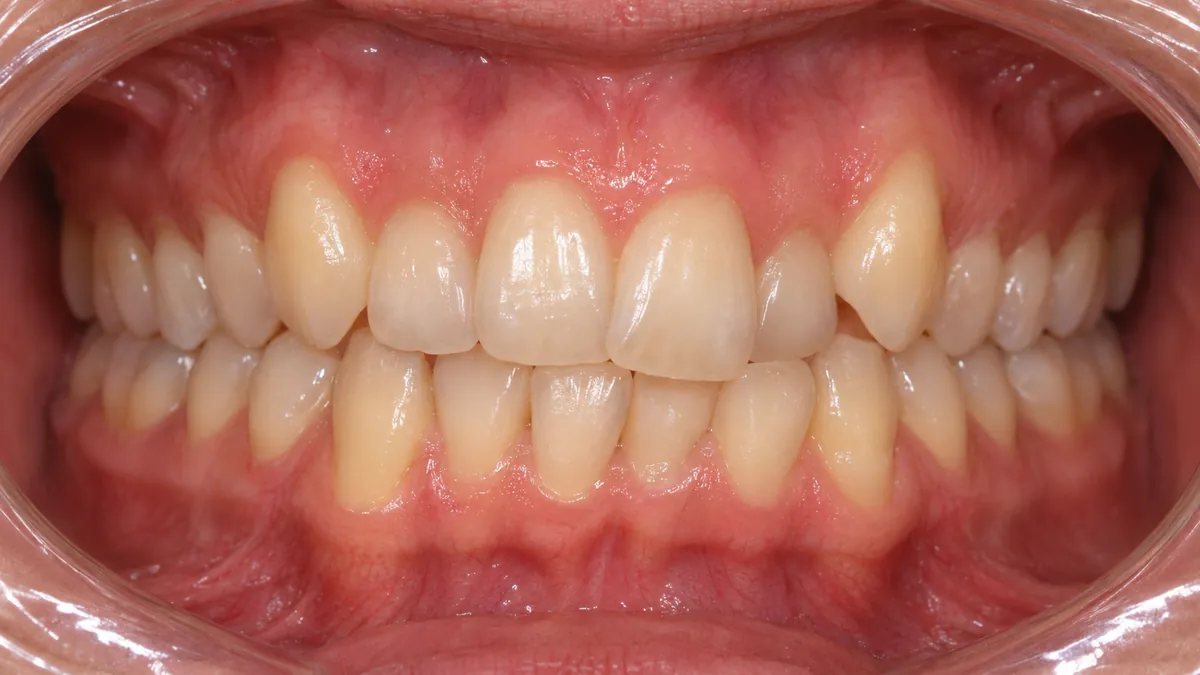
The bands are shorthand. Nobody plans treatment from them.
Is 6 mm of crowding severe?
No. Six millimetres sits in the middle of the moderate range. It is enough that space has to be found deliberately, but it is not, on its own, a reason for extractions. Some 6 mm cases need extractions. Most do not. The number has never once been the thing that decided it for me.
When Konstantonis and colleagues analysed 542 Class I patients to find out what actually drove the decision to extract, the amount of crowding mattered, but so did the position of the lower lip relative to the profile and how far forward the front teeth sat [1]. In a separate review of over 2,000 patients treated at a university clinic, the odds of extraction rose by only about 20% for each extra millimetre of crowding, and extractions were just as likely to be linked to bite problems as to crowding alone [2]. Across the same clinic’s history, extraction rates swung from 10% to over 70% and back down again over forty years, so the number on the chart was clearly not the only thing deciding it [3].
Why the number is only half the story
As crowding increases, the options for finding space change. In mild cases, small adjustments to the shape of the arch, or a small amount of polishing between several teeth, a fraction of a millimetre at each contact, may be enough. This polishing, called interproximal reduction, has been used for forty years [10] and a recent systematic review found no increase in decay, sensitivity or gum problems when it is done properly [11]. In one trial of borderline patients with 5–6 mm of crowding per arch, patients treated this way and patients treated with extractions both ended up with well-balanced profiles within normal limits; the extraction group’s lips sat about 1–1.5 mm further back [12].
As the number climbs, there are more ways to find space and more that can go wrong if the wrong one is chosen, and sometimes removing a tooth gives the best result. In a 50-year follow-up of patients who had severe crowding treated with premolar extractions in childhood, their faces and profiles at age 62 were no different from people who never had crowding at all [13].
Now the part patients rarely hear. Six millimetres of crowding in someone whose teeth and lips already sit forward is a different situation from six millimetres in someone whose front teeth stand upright behind a full lip. Same number. Different plans.
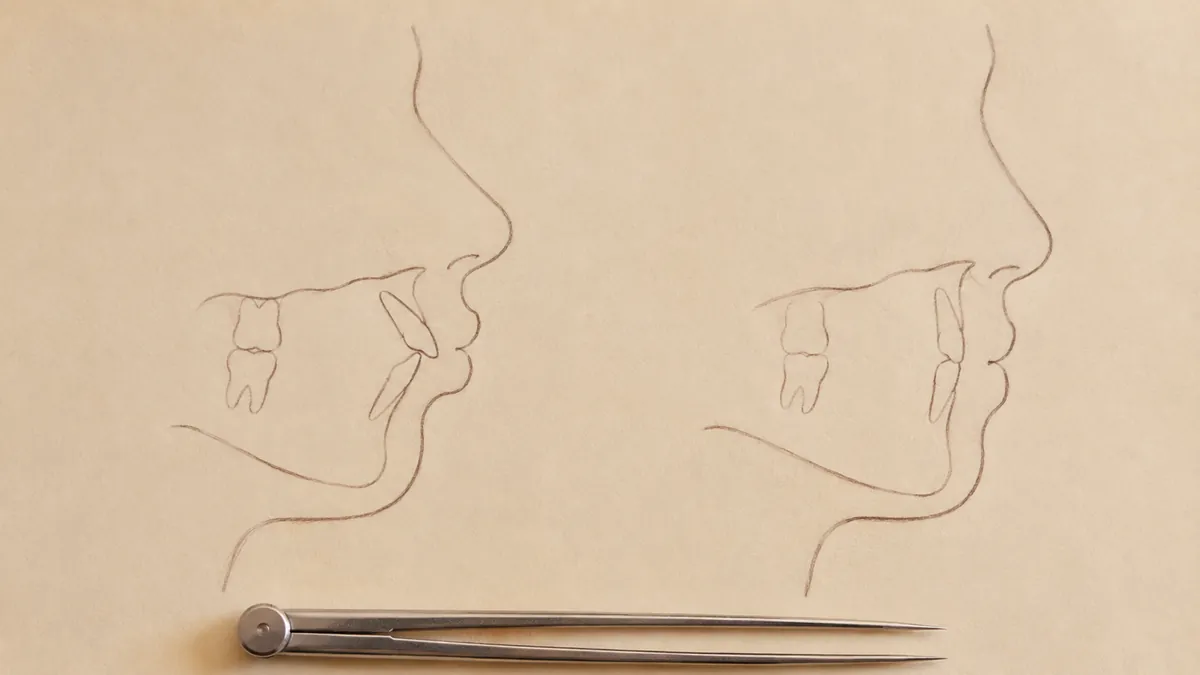
The face decides more than most people expect
The most common thing I hear in a first consultation in Dubai is “I have 6 mm of crowding, so I need extractions” or “so I can’t have aligners”. Neither follows from the number. What a specialist assessment is really looking at goes well beyond the teeth:
- The profile. Whether the teeth and lips sit forward, neutral or back changes what the right plan is, before a single tooth is moved. Study after study shows extractions leave the lips further back than non-extraction treatment [14, 15]. The most recent meta-analysis, from 2024, confirmed that lip retraction and found no difference in how attractive the smile was judged afterwards [16]. An earlier meta-analysis put the average at about 1.3 mm for the upper lip and 2 mm for the lower, but the range was wide and the authors concluded that “no consistent predictions of profile response can be made” from the extraction decision alone [17]. So I measure the profile for each patient rather than assume.
- The soft tissue. Lip thickness, the fullness of the tissue around the mouth, and how the lips rest all change how the same tooth movement will look from the outside. Thin lips follow the teeth closely; thick lips mask the movement. This was shown forty years ago, where the link between tooth movement and lip movement was very strong in thin-lipped patients and not significant in thick-lipped ones [4], and confirmed again in 2022, where patients whose lips did not meet at rest showed more lip change for the same tooth movement [5].
- The face type. Faces grow in different patterns. A longer, oval face and a shorter, broader, square face respond differently to the same mechanics. Extraction and non-extraction treatment produce small but opposite changes in the vertical proportions of the face [18], and a 2026 study found the lips retract more after extractions in long-faced patients than in average-faced ones [19]. The plan has to respect that.
- Age. A growing child, a 25-year-old and a 45-year-old can present identical crowding and need different plans, because growth is still available in one, and the soft tissue has matured and settled differently in the others. In children, some of the crowding can be managed by guiding growth and arch development while the jaws are still growing [20].
None of this is in the millimetre figure.
The difference between a snapshot and a timeline
The biggest gap between what a patient sees and what I see is time.
A patient looks at their face as it is today: a snapshot. They see the crowding, and they see how their smile looks right now.
A specialist is trained to look at the same face as a timeline. How did this face grow to get here? What is the growth pattern? How will the soft tissue change over the next ten or twenty years? It does change. Following people with normal, untreated bites from 25 to 46, the lips became more retruded relative to the nose and chin, and the crowding increased [6]. From late adolescence into the late fifties, the upper lip thins and lengthens and the nose tip drops [7]. The teeth move too: in a 50-year study of people with perfect bites who never had treatment, the lower front teeth became more crowded at every interval from 13 to 62 [8], and a separate 40-year study found the same steady narrowing of the arch through adult life [21].
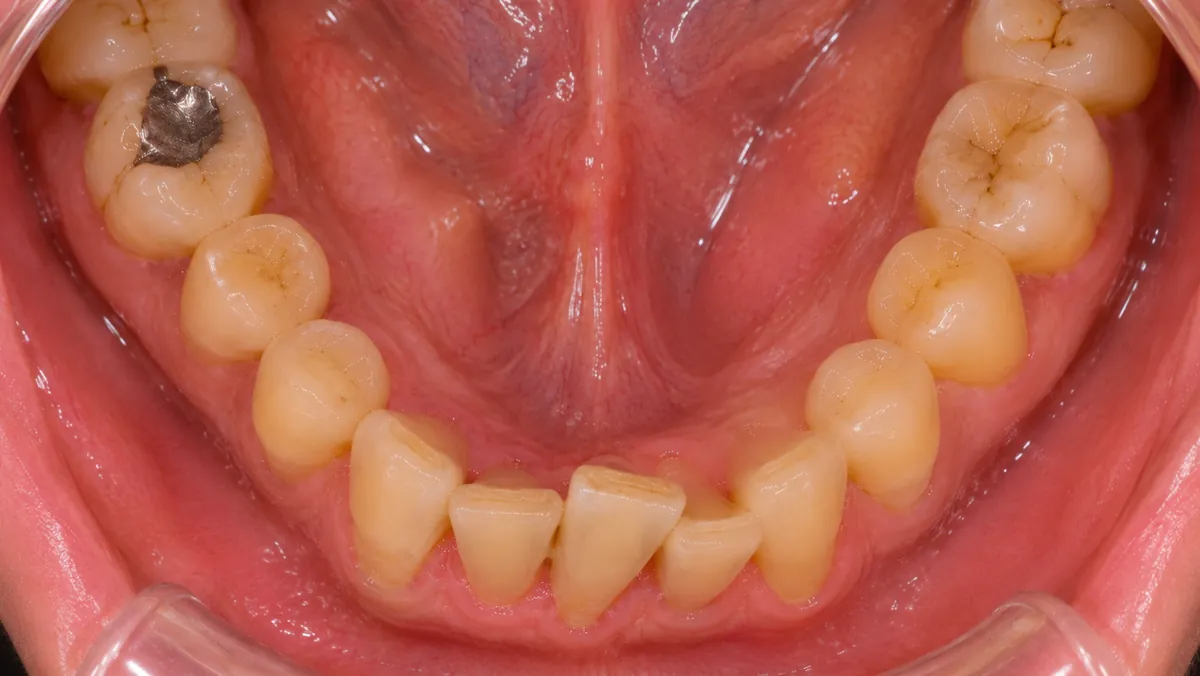
A plan that looks right today can look wrong at 45. I am planning for the face you will have, not only the one in the mirror.
What this means if you have crowded teeth
- Do not try to judge your own case by the number, or by how crooked the teeth look from the front. Mild-looking crowding can carry a difficult movement; dramatic-looking crowding can be straightforward. Over 37 years of follow-up, it was the mildly crowded cases that relapsed proportionally more, not the severe ones [22].
- A proper assessment includes photographs of the face and profile and, where needed, X-rays. If you have not had those, the plan is not finished yet.
- The right plan is specific to your face, not to your number.
The measurement describes the problem. The diagnosis decides the plan.
Does crowding mean I need teeth taken out?
No. Extraction is one of several ways to find space, and it suits some faces and not others. For one face, removing teeth is the way to resolve the crowding and keep the profile balanced. For another face with the same crowding, taking teeth out would make the profile look worse, so the space is found another way. The decision depends on the profile, the lips, the growth pattern and the bite, not on the millimetres alone [1, 2, 17].
Frequently asked questions
Is 3 mm of crowding worth treating?
Often yes, but the reason to treat is rarely the number alone. It is what the crowding is doing to the bite, to cleaning, and to the position of the front teeth. A specialist assessment tells you whether treatment is worthwhile in your case.
Can Invisalign treat crowded teeth?
Clear aligners can treat a wide range of crowding, including some moderate and severe cases. They are effective at aligning and levelling the arches [23], though the gap between what the software predicts and what the teeth actually do grows as crowding increases, which is why the plan has to be built and monitored by a specialist rather than taken straight from the simulation [24]. Whether aligners or braces are the better tool is decided case by case.
Why does my face matter if the problem is my teeth?
Because moving teeth moves the lips that rest on them [4, 5, 17]. The same tooth movement can improve one profile and unbalance another. Planning around the face is how you end up with straight teeth and still look like yourself.
How is crowding assessed at IB Clinic in Dubai?
With a full orthodontic assessment: photographs of the face and profile, a digital scan, and X-rays where they are needed.
Dr Nikhil Sharma is a specialist orthodontist at IB Clinic (Invisible Braces Dental and Skin Polyclinic) on Sheikh Zayed Road, Trade Centre, Dubai, opposite the Museum of the Future. He treats children and adults with metal, ceramic and Damon braces, Invisalign and lingual braces, including growth modification in children, profile correction in adults without surgery, and orthodontic treatment for cases that need jaw surgery.
Crowded teeth? Have them assessed properly.
Book a consultation at IB Clinic, Sheikh Zayed Road, Trade Centre, Dubai, opposite the Museum of the Future. Open 7 days, 10 am to 8 pm.
Book a consultation on WhatsApp · Call or WhatsApp 055 529 6155
References
- Konstantonis D, Anthopoulou C, Makou M. Extraction decision and identification of treatment predictors in Class I malocclusions. Prog Orthod. 2013;14:47. doi:10.1186/2196-1042-14-47. PMID 24326213.
- Jackson TH, Guez C, Lin FC, Proffit WR, Ko CC. Extraction frequencies at a university orthodontic clinic in the 21st century: demographic and diagnostic factors affecting the likelihood of extraction. Am J Orthod Dentofacial Orthop. 2017;151(3):456-62. doi:10.1016/j.ajodo.2016.08.021. PMID 28257729.
- Proffit WR. Forty-year review of extraction frequencies at a university orthodontic clinic. Angle Orthod. 1994;64(6):407-14. PMID 7864461.
- Oliver BM. The influence of lip thickness and strain on upper lip response to incisor retraction. Am J Orthod. 1982;82(2):141-9. doi:10.1016/0002-9416(82)90492-4. PMID 6961784.
- Qadeer TA, Jawaid M, Fahim MF, et al. Effect of lip thickness and competency on soft-tissue changes. Am J Orthod Dentofacial Orthop. 2022;162(4):483-90. doi:10.1016/j.ajodo.2021.05.010. PMID 35931615.
- Bishara SE, Treder JE, Jakobsen JR. Facial and dental changes in adulthood. Am J Orthod Dentofacial Orthop. 1994;106(2):175-86. doi:10.1016/S0889-5406(94)70036-2. PMID 8059754.
- Pecora NG, Baccetti T, McNamara JA Jr. The aging craniofacial complex: a longitudinal cephalometric study from late adolescence to late adulthood. Am J Orthod Dentofacial Orthop. 2008;134(4):496-505. doi:10.1016/j.ajodo.2006.11.022. PMID 18929267.
- Basim A, Naoumova J, Leffler K, et al. Digital analysis of age-related dentoalveolar changes: a 50-year longitudinal study. Prog Orthod. 2026;27(1):41. doi:10.1186/s40510-026-00643-0. PMID 42726424.
- Little RM. The irregularity index: a quantitative score of mandibular anterior alignment. Am J Orthod. 1975;68(5):554-63. doi:10.1016/0002-9416(75)90086-x. PMID 1059332.
- Sheridan JJ. Air-rotor stripping. J Clin Orthod. 1985;19(1):43-59. PMID 3882756.
- Gómez-Aguirre JN, Argueta-Figueroa L, Castro-Gutiérrez MEM, Torres-Rosas R. Effects of interproximal enamel reduction techniques used for orthodontics: a systematic review. Orthod Craniofac Res. 2022;25(3):304-19. doi:10.1111/ocr.12555. PMID 34865310.
- Germeç D, Taner TU. Effects of extraction and nonextraction therapy with air-rotor stripping on facial esthetics in postadolescent borderline patients. Am J Orthod Dentofacial Orthop. 2008;133(4):539-49. doi:10.1016/j.ajodo.2006.04.052. PMID 18405818.
- Al-Taai N, Persson M, Ransjö M, et al. Dentoskeletal and soft tissue changes after treatment of crowding with premolar extractions: a 50-year follow-up. Eur J Orthod. 2023;45(1):79-87. doi:10.1093/ejo/cjac035. PMID 35791441.
- Konstantonis D. The impact of extraction vs nonextraction treatment on soft tissue changes in Class I borderline malocclusions. Angle Orthod. 2012;82(2):209-17. doi:10.2319/051911-339.1. PMID 21932939.
- Kocadereli I. Changes in soft tissue profile after orthodontic treatment with and without extractions. Am J Orthod Dentofacial Orthop. 2002;122(1):67-72. doi:10.1067/mod.2002.125235. PMID 12142899.
- Elias KG, Sivamurthy G, Bearn DR. Extraction vs nonextraction orthodontic treatment: a systematic review and meta-analysis. Angle Orthod. 2024;94(1):83-106. doi:10.2319/021123-98.1. PMID 37899069.
- Konstantonis D, Vasileiou D, Papageorgiou SN, Eliades T. Soft tissue changes following extraction vs. nonextraction orthodontic fixed appliance treatment: a systematic review and meta-analysis. Eur J Oral Sci. 2018;126(3):167-79. doi:10.1111/eos.12409. PMID 29480521.
- Beit P, Konstantonis D, Papagiannis A, Eliades T. Vertical skeletal changes after extraction and non-extraction treatment in matched Class I patients identified by a discriminant analysis. Prog Orthod. 2017;18(1):44. doi:10.1186/s40510-017-0198-5. PMID 29250718.
- Erdem B, Başal E, Emir B. Does lip change following premolar extraction differ in patients with high and normal vertical growth patterns? Turk J Orthod. 2026;39(1):1-9. doi:10.4274/TurkJOrthod.2026.2026.4. PMID 41918489.
- Turner S, Harrison JE, Sharif FN, Owens D, Millett DT. Orthodontic treatment for crowded teeth in children. Cochrane Database Syst Rev. 2021;12(12):CD003453. doi:10.1002/14651858.CD003453.pub2. PMID 34970995.
- Tsiopas N, Nilner M, Bondemark L, Bjerklin K. A 40 years follow-up of dental arch dimensions and incisor irregularity in adults. Eur J Orthod. 2013;35(2):230-5. doi:10.1093/ejo/cjr121. PMID 22015823.
- Gambardela-Tkacz CM, Alcaraz G, Cotrin P, et al. Incisor irregularity and dental arch dimensions changes in subjects with different severity of anterior crowding: a 37-year follow-up. Prog Orthod. 2023;24(1):10. doi:10.1186/s40510-023-00461-8. PMID 36935470.
- Rossini G, Parrini S, Castroflorio T, Deregibus A, Debernardi CL. Efficacy of clear aligners in controlling orthodontic tooth movement: a systematic review. Angle Orthod. 2015;85(5):881-9. doi:10.2319/061614-436.1. PMID 25412265.
- Alulyan RY, Alamri AS, Shahin SY, et al. Influence of lower anterior crowding on the predictability of mandibular tooth movement in Invisalign therapy: a retrospective cohort analysis. Front Dent Med. 2026;6:1727909. doi:10.3389/fdmed.2025.1727909. PMID 41728355.


0 Comments